

Coastal Peoples Fine Art Gallery
New Arrivals
Home
Exhibitions
About Us
Contact Us
How to Purchase
Gift Certificates
Argillite
Basketry
Books
Glasswork
Graphics
Jewelry
Masks
Sculpture
Textiles
Totem Poles
Inuit
Maori Jewelry & Sculpture
Maps
Artist Biographies
Crest Figures
Corporate Services
Paddle Shapes
Worldwide Shipping
Careers + Opportunities
Language Translation
Gallery Locations:

Yaletown
1024 Mainland Street
Vancouver BC
Canada V6B 2T4

P: 604.685.9298
T: 1.888.686.9298
F: 604.684.9248
E: coastalpeoples@telus.net
 
Hours
Mon - Sat: 10:00am - 6:00pm
Sun + Hol: 11:00am - 6:00pm
After hours: Open by appointment only
Near Skytrain station - Yaletown/Roundhouse
Gastown
312 Water Street
Vancouver BC
Canada V6B 1B6

P: 604.684.9222
E: coastalpeoples@telus.net
 
Hours
Mon - Sat: 10:00am - 6:00pm
Sun + Hol: 11:00am - 6:00pm
After hours: Open by appointment only
Near Skytrain station - Waterfront

Gallery policy both locations:
Exchanges or store credit only
RapidSSL Site Seal
Sign In  |  New Account  |  Contact Us  |  1-888-686-9298  |  View Shopping Cart  |  Checkout
  Advanced Search

This item requires special shipping arrangements.

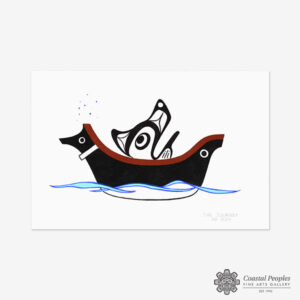
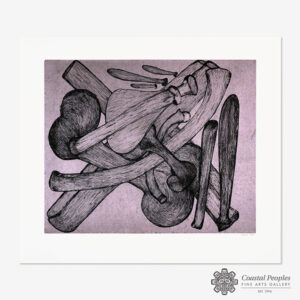
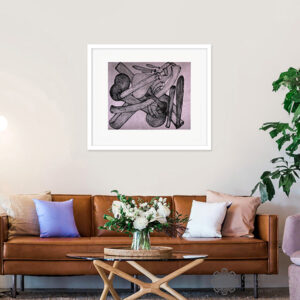
Beaver Swimming
Click the image to enlarge

Beaver Swimming

Norman Tait
Nisga’a Nation
 

Serigraph, Edition of 95

Unframed

The Beaver appears in Northwest mythology and is a family crest in many regions throughout the Northwest Coast. According to legend, the first Beaver was a woman, whose husband frequently went on long hunting and fishing trips. In his absence, his lonely wife took solace swimming, enlarging her pond with a dam and building her own water dwelling. Eventually, she transformed into a Beaver and their children were Beaver People, founding the Beaver lineage.

In mythology, they are often associated with the powerful undersea supernatural beings and the magic Giant Beaver can cause natural disaster with one slap of its wide, strong tail. Characterisically, the Beaver is known to keep to himself and cares little for the activities of the humans, except when they are directly affected. Thus, they often give wise advice so it is important to listen when they do decide to speak.

22" x 28"
CAD $580.00

No. 852
CP-Yaletown
All measurements height x width x depth

Inquire about this piece  |  View more work by this artist
Add to shopping cart
Norman Tait, Nisga’a Nation
 

Born in 1941 in Kincolith, BC, Norman Tait is a decedent of the master carver Oyai. He was educated by elders in Nisga’a oral tradition and ceremony. He attended residential school in Edmonton, then high school in Prince Rupert before becoming a millwright in a pulp mill. After moving to Vancouver in 1971, he began carving seriously. His reputation was established in 1973 with his first totem pole, carved with his father Josiah and erected to commemorate the incorporation of Port Edward. It was the first Nisga’a pole raised in more than fifty years. He has produced numerous totem poles, including one, Big Beaver, for the Field Museum in Chicago; one privately commissioned and donated to the Heard Museum in Phoenix, Arizona, and one for the British Royal family, erected in Bushy Park, London, in 1992.

As an internationally acclaimed artist, Norman’s talent continues to flourish in the more recent works he has created. He is not only a master in large scale but also in miniatures. His dedication to preserving his ancestry in the traditional design style is evident in each piece of artwork. He prides himself on his knowledge of his language and cultural traditions and periodically takes on projects with his partner of many years, Lucinda Turner.

Other original works are located in Osaka, Phoenix, Chicago, London, North Vancouver and at the Museum of Anthropology at the University of British Columbia. Norman also took part in the carving of a frontal pole for the Native Education Centre in Vancouver, an event documented in Vickie Jensen’s book, Where the People Gather (1992).

Norman’s timing, like many great artists was impeccable. For First Nations people, the early 1970’s fomented with a new energy. Through their landmark court challenge, Nisga’a political leaders were demanding self-government and new rights.

Norman soon realized that Nisga’a carving, dancing and other art would have to be resurrected if they were to survive. He began to form strong opinions on how his carvings would interpret traditional Nisga’a themes in new, contemporary ways – driven by the belief that art must grow in order to survive.